“Humans and Machines making magic together”
I’m researching and developing interaction capabilities to promote agile teams in the concept of “Human-Robot Teams” (HRTs).
My plan to allow these team to communicate get the interactions between Humans and Robots in teams to be similar to those of humans and pets and beasts of burden or even small children. I intend to accomplish this by using multi-modal communications to build context around a subject and establish a common ground between all team members.
Key Activities and Recognition
- Accenture CTO tweet during Robot Week:
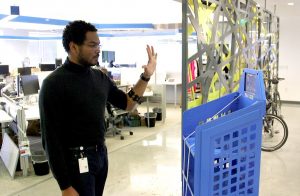
Happy #RoboWeek everyone, and especially to our #robotics researchers in @AccentureLabs! Sharing a few pics of @Taurean_Dyer and Nick Akiona with Fetch. pic.twitter.com/kdMMYGIzoU
— Paul Daugherty (@pauldaugh) April 12, 2018
- CHI Convention Panel Paper – Contributor
- Hannover Messe – under “HUMANS AND MACHINES MAKING MAGIC TOGETHER”
Why is this important?
Right now, interactions between humans and robots have been largely siloed and sequestered due to several reasons.
- Traditional thinking prevails: Let’s use a dishwasher as an example. Few people think of a dishwasher that works with you washing the dishes by rinsing off the dishes as you hand them over. You think of machine that you prepare the initial product (dirty dishes) in the robot’s work space, a few buttons are pressed, and the robot does an action upon the product (washing, rinsing, and drying the dishes) until the end product is produced to some acceptable efficacy (mostly spotlessly clean dishes). It is then handed back off the the human.
- Engaging with robots are through channels that break the work flow for human team mates in such a way that it is not conducive to have continuous interactions
- Working in the robot’s work space can be dangerous -When a human enters the robot’s work space, that human can get very hurt. In fact, collaborative robots, or co-bots, today are considered robots that will only incur one hospital day or less for the injured person if an accident happens. No one opens a dishwasher and helps it while it’s running and expects not to get hurt.
But that can’t be the rules that dictate the future. There will be labor and talent shortfalls in the near future, and people and AI have to work better together if we are to continue our economic growth. I believe we can do better than that.
What does this involve?
- Putting the right sensor inputs and feedback outputs on both the humans and robot teammates
- Creating a way that the necessary data from each team member is properly captured or formed for translation use
- Enabling the translations of the desired actions into an output each team member can understand.
- Accelerating the capabilities so that it is democratized and scalable
Why pets, beasts of burden, and small children?
- Animals tend to understand simple instructions, but have a very rudimentary response capability, forcing the human agent to interpret what they require. When you ask a dog what’s wrong with it, the dog barely understands you, and you its possible response. That requires an expensive trip to the vet due to all the testing!
- Small children greatly reduce the amount of interpretation needed when communicating with other children or adults, as a great common ground has been established. When you ask a child what is wrong with it, they can at least say their stomach hurts. You can either self diagnose and treat, or decide to take them to the expensive pediatrician